

2026 ≠ 2022: Why This Rally Deserves Respect, Not Fear
The Markets
“Purchase price matters.” — Marc Rowan, CEO, (Apollo Global Management)
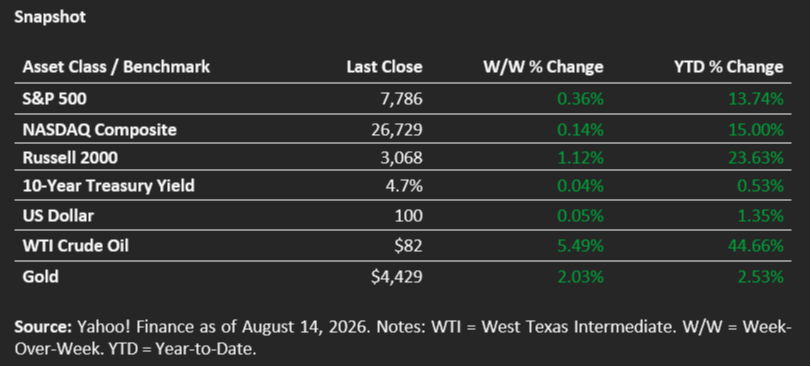
U.S. equity markets posted strong gains this week, with broad participation across major indexes. The S&P 500 advanced +0.36%, lifting its year-to-date return to +13.74%. Technology shares led the advance, as the NASDAQ Composite gained +0.14%, bringing its year-to-date return to +15.00%. Small-cap stocks also participated, with the Russell 2000 rising +1.12% and extending its impressive year-to-date gain to +23.63%.
In fixed income, the 10-Year Treasury yield increased +0.04%, finishing the week at 4.7%. The modest move suggests that bond markets remained relatively stable even as equities rallied strongly.
The U.S. dollar edged higher by +0.05%, bringing its year-to-date gain to +1.35%. The relatively muted move in the dollar contrasted with the stronger price action seen across equities and commodities.
Commodity markets also moved higher. WTI crude oil advanced +5.49%, extending its year-to-date gain to +44.66%. Gold rose +2.03% during the week, moving back into positive territory for the year with a +2.53% year-to-date return.
Overall, this week's market action reflected a broadly constructive environment. Large-cap equities rallied, technology provided leadership, small caps participated, and both oil and gold advanced. At the same time, Treasury yields and the U.S. dollar moved only modestly, creating a backdrop in which risk assets were able to post meaningful gains.
As Marc Rowan reminds us, “purchase price matters.” Strong markets can create enthusiasm, but disciplined investing still requires balancing opportunity with valuation and risk. This week's broad advance is encouraging, yet the long-term investment lesson remains the same: focus on fundamentals, remain disciplined, and evaluate opportunities based on the value received for the risk taken.
2026 ≠ 2022
Think of 2022 as the market trying to run uphill with a refrigerator strapped to its back.
2022:
🔥 Inflation: 8.3%
🏦 Fed: Aggressively tightening
💰 Financial conditions: Tightening
🚢 Supply chains: Severely disrupted
📉 Earnings: Deteriorating
2026:
🌤️ Core inflation: 2.6%
🏦 Fed: Neutral/supportive
💳 Financial conditions: Accommodative
🚢 Supply chains: Normalizing
📈 Earnings: Accelerating
The difference is enormous. S&P 500 earnings growth went from -5.0% in 4Q22 to a stunning +50.4% in 2Q26, with analysts still expecting double-digit growth through year-end.
As economist Paul Samuelson famously quipped, “The stock market has predicted nine of the last five recessions.” Investors may want to remember that before predicting recession No. 10.
- A Softer Labor Market Is Actually Good News
In 2022, unemployment averaged just 3.7%—too hot for comfort. In 2026, it's averaging 4.3%, suggesting a healthier balance between workers and employers.
In other words, the labor market has gone from “Help Wanted!” to “Help Wanted, But Let's Not Get Crazy.”
That moderation helps cool wage pressure without necessarily signaling recession.
- Inflation Has Lost Its Temper
Average headline CPI has fallen from 8.3% in 2022 to 3.3% in 2026, while core CPI has dropped to 2.6%.
That's a pretty dramatic transformation.
The Fed doesn't need to slam on the brakes when the economy is already moving at a reasonable speed. As former Fed Chair Alan Greenspan once said, “The purpose of forecasting is not to predict the future but to tell you what you need to know to take action in the present.”
- Supply Chains Are No Longer the Villain
The Global Supply Chain Pressure Index has fallen from an average of +2.8 standard deviations in 2022 to +1.1 in 2026.
Translation: Fewer empty shelves, fewer shipping nightmares and fewer corporate executives blaming the supply chain for everything short of bad weather.
That normalization is helping contain costs and protect profit margins.
- The Fed Isn't Coming for Your Bull Market
The federal funds rate has changed 0.0% YTD. That's a remarkable contrast with 2022, when the Fed was rapidly removing monetary accommodation.
Today's Fed isn't necessarily stepping on the accelerator—but it isn't standing on the brake, either.
- Financial Conditions Are Still Friendly
The Goldman Sachs Financial Conditions Index has barely moved by 0.1% YTD, compared with 2.2% in the first seven months of 2022.
Liquidity and credit remain supportive of economic activity. That's hardly the recipe for an imminent financial-market train wreck.
- And Then There's Earnings
This is the big one.
S&P 500 EPS growth:
- 1Q22: +9.4%
- 4Q22: -5.0%
- 1Q26: +28.8%
- 2Q26: +50.4%
- 3Q26E: +27.4%
- 4Q26E: +25.2%
That's not an earnings recession. That's an earnings revival with a caffeine problem.
Human Interest
Markets aren't the only things that occasionally get anxious.
Imagine going to the doctor and being told, “Your blood pressure is higher than last year, but your cholesterol is down, your heart is stronger and your lungs are working better.”
You probably wouldn't immediately start writing your will.
That's essentially today's market: One metric may look uncomfortable, but the overall patient is considerably healthier than in 2022.
As Winston Churchill put it, “If you're going through hell, keep going.” Fortunately, 2026 looks considerably more like heaven compared to the hell we endured in 2022.
Fun Facts & Figures
📊 4.3%: Average unemployment in 2026.
🔥 8.3%: Average headline inflation in 2022.
🚀 50.4%: S&P 500 EPS growth in 2Q26.
🐂 18.11%: Russell 2000 YTD gain.
🧯 0.0%: YTD change in the federal funds rate.
The market's message? Different year. Different environment. Different playbook.
On This Day in History – August 17
On August 17, 1960, the Soviet Union launched Sputnik 5, carrying two dogs, Belka and Strelka, into orbit. They became the first animals to orbit Earth and return safely.
The lesson for investors? Sometimes the best way to discover whether something works is to put it into orbit and see what happens.
As Yuri Gagarin famously said after becoming the first human in space: “Let's go!”
For today's bulls, that sentiment seems oddly appropriate.
Bottom Line
2022 was a macroeconomic obstacle course. 2026 is a very different animal.
Cooler inflation. A less hostile Fed. Healthier financial conditions. Normalizing supply chains. And, most importantly, booming earnings.
Could the market correct? Of course. Markets always can.
But comparing 2026 with 2022 and expecting the same ending is like watching a rerun of Jaws and assuming every swimming pool contains a shark.
Our view: Respect the rally. Don't fear it.
Best regards,
Andrew Zittell
Yerba Buena Financial Partners
P.S. – Please feel free to forward this commentary to family, friends, or colleagues. If you would like us to add them to the list, please reply to this email with their email address and we will ask for their permission to be added.