Is the Fed Fighting Yesterday’s Inflation?
The Fed may be looking in the rearview mirror while the economy is already turning the corner.
Despite an uneventful Federal Open Market Committee meeting, some policymakers remain concerned about stubborn inflation. But the data suggest underlying inflation momentum is behaving just as economic theory would predict—and another round of monetary tightening could do more harm than good.
The key distinction? Inflation driven by excessive demand is different from inflation driven by supply shocks.
As newly minted 2026 Nobel laureate Michael Woodford’s framework helps explain, when demand exceeds the economy’s productive capacity, prices face upward pressure. But when supply disruptions are the culprit, the Fed needs to be careful not to treat every price increase like an overheated economy.¹
In other words, don't bring a sledgehammer to fix a squeaky door.
Inflation: Sticky Is as Sticky Does
Our research points to a relatively balanced economy, with economy-wide capacity utilization and changes in the output gap suggesting limited demand-driven inflation pressure.
Here's the interesting part:
- Sticky-price inflation: 2.82% — relatively restrained.
- Flexible-price inflation: 6.12% — considerably hotter, but also more volatile.
What's driving much of the headline inflation noise? External supply shocks, particularly energy pressures associated with geopolitical conflict.
If tensions in the Middle East ease, flexible-price inflation could cool considerably.
That matters because the Fed shouldn't keep tightening monetary policy to fight an inflation problem that may be resolving itself.
As Nobel laureate Milton Friedman famously observed, *“Inflation is always and everywhere a monetary phenomenon.”*² But identifying the source and persistence of price pressures is essential before reaching for the policy brakes.
Fed: Do No Harm!
Another round of tightening could create unnecessary collateral damage.
Bonds: Cooling inflation momentum, attractive yields and better valuations could provide support for government bonds. A bond-market rally could also ease pressure on interest-rate-sensitive stocks.
Consumers: Lower energy costs and borrowing rates would give households some breathing room. Consumer Discretionary and Consumer Staples stocks could benefit from improving purchasing power and reduced financial pressure.
🏁 Bottom Line
Don't mistake supply-driven inflation for an overheated economy.
Core inflation momentum is behaving predictably relative to changes in the output gap, while economy-wide capacity utilization remains broadly balanced.
Further Fed tightening risks creating unnecessary economic damage, particularly in vulnerable credit markets and consumer-related stocks.
Bonds could benefit from cooling inflation, while consumers and interest-rate-sensitive equities could enjoy some much-needed relief.
The Fed doesn't need to break something to prove it's fighting inflation.
👨👩👧👦 Human Interest: The Grocery Store Test
Imagine going to the supermarket and discovering that eggs, gasoline and groceries are more expensive because of a supply disruption.
Would you want the Fed to raise interest rates until your mortgage, car loan and credit-card payments became even more expensive?
Probably not!
That's the challenge policymakers face. They need to distinguish between an economy that's spending too much and one that's simply paying more because something has become harder to produce or deliver.
As Franklin D. Roosevelt said in his first inaugural address, *“The only thing we have to fear is fear itself.”*³ Investors—and policymakers—should be careful not to let inflation anxiety become its own economic problem.
🤓 Fun Facts & Figures
A few numbers worth remembering:
- 2026: Robert Hall and Michael Woodford won the Nobel Prize in Economic Sciences for their work on the microeconomic foundations of macroeconomic stabilization.¹
- 6.12%: Flexible-price inflation—the volatile troublemaker.
- 2.82%: Sticky-price inflation—the comparatively well-behaved sibling.
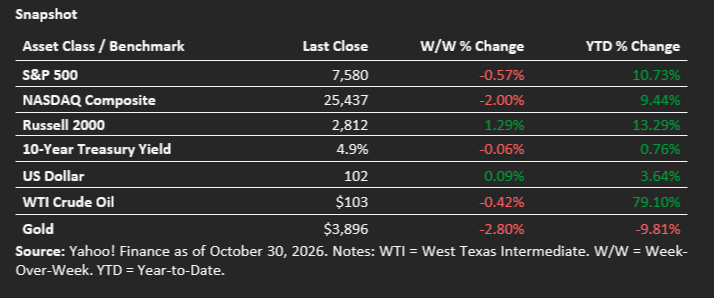
- 4.93%: Yields have responded to cooling inflation momentum, supporting the case for bonds.
- Two sides of inflation: Supply-driven price increases and demand-driven price increases aren't the same animal.
Physicist Richard Feynman offered a useful reminder: *“The first principle is that you must not fool yourself—and you are the easiest person to fool.”*⁴ That's good advice for interpreting economic data, too. Don't let one noisy inflation reading obscure the bigger picture.
📅 On This Day in History — November 2
1889: North Dakota and South Dakota became the 39th and 40th states. Two states for the price of one!⁵
1947: Howard Hughes piloted the enormous H-4 Hercules, better known as the Spruce Goose, on its first—and only—flight. The massive wooden aircraft flew roughly one mile. Sometimes the biggest projects don't need a long runway to make history.⁶
1982: President Ronald Reagan signed legislation establishing Martin Luther King Jr. Day as a federal holiday.⁵
A fitting thought from Dr. King: *“The time is always right to do what is right.”*⁷
That applies to monetary policy, too: good decisions require looking beyond the immediate headlines.
Best regards,
Andrew Zittell
Yerba Buena Financial Partners
P.S. – Please feel free to forward this commentary to family, friends, or colleagues. If you would like us to add them to the list, please reply to this email with their email address and we will ask for their permission to be added.