

Markets in Motion
The Markets
“The market is constantly weighing probabilities, not certainties. Successful investing comes from recognizing when expectations have become disconnected from reality.” — Lee Ainslie, (Maverick Capital)
U.S. equity markets pulled back this week as investors reassessed risk following a strong first half of the year. The S&P 500 declined –1.89%, though it remains higher by +7.49% year-to-date. Technology stocks experienced a sharper correction, with the NASDAQ Composite falling –4.60%, trimming its year-to-date gain to +8.84%. In contrast, small-cap stocks continued to show relative resilience, with the Russell 2000 advancing +0.82%, extending its year-to-date gain to +20.63%. The divergence in performance suggests investors continued rotating beyond large-cap growth stocks in search of broader market opportunities.
In fixed income, the 10-Year Treasury yield declined –0.08%, finishing the week at 4.4%. The modest decline in yields provided some support for interest-rate-sensitive sectors and suggests bond investors remain relatively comfortable with the current inflation and economic outlook.
The U.S. dollar rose +0.48%, lifting its year-to-date gain to +3.10%. A firmer dollar can create headwinds for commodities and multinational earnings, though its impact was overshadowed by broader market positioning during the week.
Commodity markets weakened across the board. WTI crude oil declined –9.37%, though it remains higher by +20.90% year-to-date. The sharp pullback reflected a reduction in the geopolitical risk premium as concerns over a major disruption to Middle East energy supplies eased, while profit-taking followed oil's strong advance earlier in the year. Gold also declined –3.21%, extending its year-to-date loss to –5.48%. The combination of a stronger U.S. dollar and easing demand for traditional safe-haven assets weighed on precious metals during the week.
Taken together, the cross-asset landscape reflects a market undergoing a healthy recalibration rather than a broad deterioration in fundamentals. Large-cap equities paused after an extended advance, small-cap stocks continued to outperform, Treasury yields edged lower, and commodity prices retreated as geopolitical concerns moderated. While volatility may persist, market leadership continues to broaden—a characteristic that has historically been supportive of durable bull markets rather than signaling their end.
As Lee Ainslie reminds us, markets are constantly weighing probabilities, not certainties. This week’s rotation shows why disciplined investors focus less on short-term noise and more on whether expectations remain aligned with fundamentals.
Snapshot
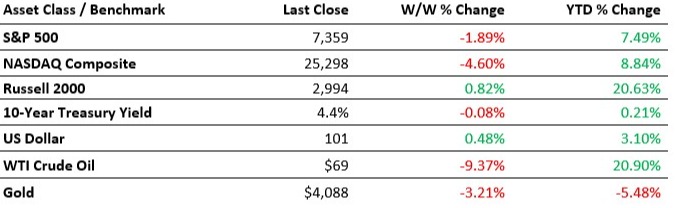
Source: Yahoo! Finance as of June 26, 2026. Notes: WTI = West Texas Intermediate. W/W = Week-Over-Week. YTD = Year-to-Date.
The Wisdom of Breadth
"The stock market is filled with individuals who know the price of everything, but the value of nothing.” — Philip Fisher
One of the greatest challenges in investing is resisting the temptation to focus only on headlines. After all, investors have endured persistent inflation, two major geopolitical conflicts, historically low consumer sentiment, and nearly $8 trillion sitting in money market funds. With so many reasons to be cautious, it would be easy to assume the market's best days are behind us.
Yet beneath the surface, a different story continues to unfold.
Rather than concentrating on a handful of high-profile stocks, WCG's trend research reviews approximately 5,000 stock charts using a disciplined, objective process that focuses solely on price trends and moving averages. Stocks are scored without knowing their ticker symbols, helping remove emotional bias from the evaluation process.
The encouraging takeaway is not simply that markets have advanced—it is how broadly participation has expanded. Growth stocks continue to lead, but improvements have also emerged across blend and value styles, while more than 62% of Russell 3000 companies remain above their 200-day moving averages. Healthy bull markets are often characterized by broad participation rather than leadership from only a select few companies.
As legendary investor Peter Lynch once said: “Know what you own, and know why you own it.”
Breadth reminds investors that opportunity often exists beyond the names dominating financial headlines. Sometimes the strongest markets are the ones where many different companies, sectors, and investment styles quietly contribute to long-term success.
Wall Street Wisdom
"The biggest investing errors come not from factors that are informational or analytical, but from those that are psychological." — Howard Marks
One of the recurring themes in successful investing is managing emotions. Markets will always experience periods of optimism and pessimism, but long-term results are often determined by an investor's ability to remain disciplined rather than react to short-term headlines. As Howard Marks frequently reminds investors, understanding market cycles and controlling emotional decision-making are often more valuable than trying to predict the next market move.
Innovation Watch
“Innovation is the ability to see change as an opportunity—not a threat." — Steve Jobs
Artificial intelligence is beginning to transform pharmaceutical research by helping scientists identify promising drug candidates faster than traditional methods. What once required years of laboratory testing can now be accelerated through machine learning models that analyze billions of biological interactions.
For investors, this trend extends beyond healthcare. AI continues to reshape industries ranging from manufacturing and cybersecurity to financial services and transportation. While adoption will likely vary across sectors, the long-term productivity gains could become one of the defining investment themes of the next decade.
Human Interest
Sometimes the Best Decisions Are the Quiet Ones
Professional pilots are trained to trust their instruments, especially when flying through thick clouds. Looking out the window can be misleading, but the instruments provide objective information that helps guide better decisions.
Investing works much the same way.
Market headlines, social media, and 24-hour news cycles can create plenty of turbulence. Yet disciplined investors often rely on objective data—earnings, valuations, technical trends, and market breadth—rather than emotion.
As author James Clear reminds us:
“You do not rise to the level of your goals. You fall to the level of your systems.”
Successful investing, much like successful flying, often depends more on following a disciplined process than reacting to every headline.
Fun Facts & Figures
“The stock market is a device for transferring money from the impatient to the patient.” — Warren Buffett
📈 The S&P 500 has gained more than 117% since its October 2022 low (through June 25, 2026).
📊 Approximately 5,000 stock charts are reviewed during WCG's trend analysis process.
✅ More than 62% of Russell 3000 companies currently trade above their 200-day moving average—a sign of healthy market participation.
💵 Investors continue to hold roughly $8 trillion in money market funds, reflecting that significant capital remains on the sidelines.
📚 WCG's research evaluates five key investment factors: Trend, Value, Momentum, Quality, and Low Volatility.
On This Day in History – June 29
“Innovation distinguishes between a leader and a follower.” — Steve Jobs
Apple Introduces the iPhone (2007)
On June 29, 2007, Apple released the original iPhone, forever changing the way people communicate, work, shop, and access information.
At the time, many questioned whether consumers needed a device that combined a phone, music player, internet browser, and touchscreen computer. Less than two decades later, smartphones have become indispensable, reshaping industries ranging from banking and healthcare to transportation and investing.
The iPhone serves as a reminder that transformative innovations often face skepticism before becoming part of everyday life. Today's advancements in artificial intelligence, robotics, and space technology may follow a similar path.
Other June 29 Milestones
💡 1613 — William Shakespeare's Globe Theatre was destroyed by fire during a performance of Henry VIII. It was rebuilt the following year and remains one of the world's most iconic theatrical landmarks.
🚂 1880 — France officially annexed Tahiti, expanding its influence in the South Pacific and shaping the region's political and cultural history.
📱 2007 — The original Apple iPhone officially went on sale in the United States, ushering in the modern smartphone era.
🏛️ 1956 — President Dwight D. Eisenhower signed the Federal-Aid Highway Act, authorizing construction of the U.S. Interstate Highway System—one of the largest infrastructure projects in American history.
🎭 2009 — Bernard Madoff was sentenced to 150 years in prison for orchestrating one of the largest Ponzi schemes in financial history, reinforcing the importance of transparency, due diligence, and investor protection.
Best Regards,
Andrew Zittell
Yerba Buena Financial Partners
Sources & Footnotes:
- WCG Weekly Market & Technical Momentum Input – June 24, 2026.
- Bloomberg, S&P 500 total return data (October 12, 2022 – June 25, 2026).
- Morningstar Research – Trend Factor by Style Box analysis.
- University of Michigan Surveys of Consumers – Consumer Sentiment Index.
- Investment Company Institute – Money Market Mutual Fund Assets.
- Bloomberg – Russell 3000 companies above their 200-day moving averages (June 25, 2026).
- Apple Inc. – iPhone Launch History (June 29, 2007).
- Walter Isaacson, Steve Jobs (2011).
- James Clear, Atomic Habits.
- Warren Buffett, Berkshire Hathaway Shareholder Letters.
Disclosures:
- Securities offered through LPL Financial, Member FINRA/SIPC. Investment Advice offered through WCG Wealth Advisors, LLC, a Registered Investment Advisor. WCG Wealth Advisors, LLC is a separate entity from LPL Financial.
- Bond yields are subject to change. Certain call or special redemption features may exist which could impact yield. (118-LPL)
- The S&P 500 is a stock market index tracking the stock performance of 500 of the largest companies listed on stock exchanges in the United States. Indexes are unmanaged and cannot be invested in directly. (102-LPL)
- The NASDAQ Composite Index measures all NASDAQ domestic and non-U.S. based common stocks listed on The NASDAQ Stock Market. The market value, the last sale price multiplied by total shares outstanding, is calculated throughout the trading day, and is related to the total value of the Index. Indexes are unmanaged and cannot be invested in directly. (112-LPL)
- The fast price swings in commodities will result in significant volatility in an investor’s holdings. Commodities include increased risks, such as political, economic, and currency instability, and may not be suitable for all investors. (122-LPL)
- There is no guarantee that a diversified portfolio will enhance overall returns or outperform a non-diversified portfolio. Diversification does not protect against market risk. (26-LPL)
The Russell 2000 Index is generally representative of the 2,000 smallest companies by market capitalization in the Russell 3000 index, which represents approximately 10% of the total market capitalization of the Russell 3000 Index. Indexes are unmanaged and cannot be invested in directly. Bonds are subject to market and interest rate risk if sold prior to maturity. Bond values will decline as interest rates rise. Bonds are subject to availability, change in price, call features and credit risk. The fast price swings in commodities will result in significant volatility in an investor’s holdings. Commodities include increased risks, such as political, economic, and currency instability, and may not be suitable for all investors.
Securities offered through LPL Financial, Member FINRA/SIPC. Investment Advice offered through WCG Wealth Advisors, LLC, a Registered Investment Advisor. WCG Wealth Advisors, LLC is a separate entity from LPL Financial.