

Mixed Earnings, Solid Foundations: Don’t Confuse a Speed Bump With a Flat Tire
The Markets
“I wanted to build a portfolio that strived for consistent, attractive returns without taking on large amounts of risk.” — Salem Abraham, President & Head Researcher, Abraham Trading Company.
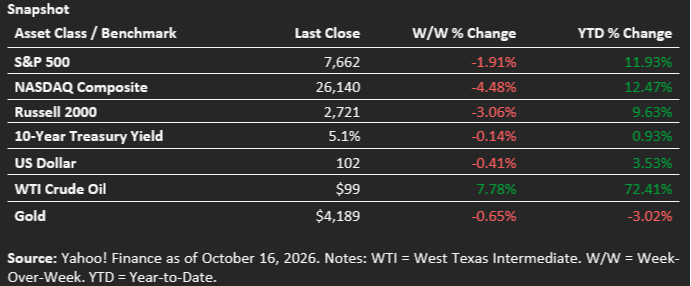
U.S. equity markets moved lower during the week. The S&P 500 declined 1.91%, bringing its year-to-date gain to 11.93%. The NASDAQ Composite declined 4.48%, though it remains up 12.47% year-to-date. Small-cap stocks also retreated, with the Russell 2000 declining 3.06%, reducing its year-to-date gain to 9.63%.
In fixed income, the 10-Year Treasury yield declined 0.14%, finishing the week at 5.1%. The U.S. dollar declined 0.41%, while remaining up 3.53% year-to-date.
Commodities were mixed. WTI crude oil advanced 7.78%, finishing the week at $99 per barrel and extending its year-to-date gain to 72.41%. Gold declined 0.65%, finishing at $4,189, bringing its year-to-date return to a decline of 3.02%.
Overall, the week was characterized by weakness across equities, particularly technology and small-cap stocks, while Treasury yields and the U.S. dollar moved modestly lower. Oil stood out with a strong weekly advance, highlighting the continued divergence across asset classes.
Salem Abraham’s investment philosophy provides a fitting perspective for a week like this. Abraham Trading’s approach has long emphasized systematic investing, diversification, and disciplined risk management rather than relying on a single market outcome.
Mixed Banks, Strong Foundations
If you doubt the analysts, listen to the companies.
Corporate America is still talking its book—and the message remains surprisingly upbeat. According to FactSet, 28 S&P 500 companies issued positive EPS pre-announcements for 3Q26, the highest net number since 2Q21.
As Warren Buffett famously put it, “The stock market is a device for transferring money from the impatient to the patient.” Right now, patience may be getting paid.
Tech Still Leads the Parade
Technology remains the market’s cheerleader.
Information technology produced a record 44 positive EPS pre-announcements, led by software (12) and semiconductors & semiconductor equipment (11).
The global semiconductor ecosystem is backing up the story. Taiwan Semiconductor Manufacturing Company (TSMC) just reported record quarterly profit, with net income up 69% Y/Y, while ASML reported strong AI-driven demand and raised its 2026 revenue outlook.
In other words: the AI engine is still humming.
“The future depends on what you do today.” — Mahatma Gandhi
A nice thought for investors—and for anyone who has ever put off assembling IKEA furniture until Sunday night.
Big Banks: Mixed Results, Positive Outlook
The banking story is more nuanced than last quarter.
Goldman Sachs, Citigroup and Morgan Stanley delivered strong revenue growth and capital-markets performance. JPMorgan, Bank of America and Wells Fargo were less impressive on the top line, while higher credit provisions weighed on some bottom-line results.
That isn't necessarily a warning sign. Financials are mature businesses, so they aren't expected to grow like semiconductor companies riding an AI rocket.
The bigger picture remains constructive:
- C&I loan growth: 10% Y/Y
- Banking NIM: 3.3%
- Bank ROA: 1.4%
- Bank ROE: 13.8%
- 2s10s yield curve: positively sloped
- Financial stress: subdued
Think of it as a house with a few rooms that need repainting—but the foundation is solid.
And yes, Bank of America has some homework to do: Treasury agencies announced more than $1.21 billion in penalties related to anti-money-laundering and sanctions compliance.
Why We're Still Optimistic
Seven fundamental tailwinds keep the financial-sector story alive:
- Commercial lending is growing.
- The yield curve has normalized.
- Net interest margins are improving.
- Banks are optimizing capital.
- Financial-system stress remains low.
- Seasonal trading and investment-banking activity should help.
- M&A and IPO activity could accelerate into 1Q27.
The key distinction: mixed earnings don't equal broken fundamentals.
The banking system is making money, extending credit and returning capital. That's a pretty good job description for a bank.
Bottom Line
The 3Q26 banking season isn't as uniformly spectacular as 2Q26—but that's not the same thing as deterioration.
The broader evidence still points to:
Healthy lending + normalized yield curve + solid capital returns + low financial stress + strong corporate guidance = constructive foundations.
Money isn't necessarily leaving the market.
It's rotating.
So, in the immortal spirit of market sanity:
Don't fear the transition. Follow the fundamentals.
Human Interest: Don't Confuse a Speed Bump With a Flat Tire
Markets rarely move in straight lines.
Some companies accelerate. Others slow down. Some analysts panic. Some investors sell perfectly good businesses because somebody on television sounded concerned.
That's why legendary investor Peter Lynch's simple philosophy remains useful: “Know what you own, and know why you own it.”
The lesson isn't to ignore bad news. It's to put bad news in context.
Fun Facts & Figures
$1.21 billion: The combined headline figure associated with Treasury's October 13 enforcement actions against Bank of America.
69%: TSMC's latest quarterly profit growth—a reminder that the semiconductor boom hasn't exactly misplaced its accelerator pedal.
44: Positive technology-sector EPS pre-announcements in 3Q26.
13.8%: Approximate ROE implied by the banking-sector ROA and equity multiplier.
As Norman Cousins observed, “Wisdom consists of the anticipation of consequences.” In markets, that sounds suspiciously like risk management.
On This Day in History — October 19
1781: British General Cornwallis surrendered at Yorktown, effectively ending major fighting in the American Revolution. About 8,000 British soldiers and sailors surrendered.
1987: The Dow Jones Industrial Average plunged 22.6% on Black Monday—the largest one-day percentage decline in its history.
Two very different October 19ths. One ended a war. The other started a very bad Monday.
The historical lesson? Never confuse today's headline with tomorrow's outcome.
As historian Norman Cousins put it, “History is a vast early warning system.”
Best regards,
Andrew Zittell
Yerba Buena Financial Partners
P.S. – Please feel free to forward this commentary to family, friends, or colleagues. If you would like us to add them to the list, please reply to this email with their email address and we will ask for their permission to be added.
Sources & Footnotes:
- FactSet: S&P 500 earnings guidance and 3Q26 pre-announcements; WCG analysis, 10/14/26.
- Seeking Alpha: Company earnings, revenue, EPS and consensus-estimate data; WCG analysis, 10/14/26.
- Taiwan Semiconductor Manufacturing Company (TSMC): 3Q26 financial results; corroborated by Reuters.
- ASML: 3Q26 results and 2026 outlook; corroborated by Reuters.
- Federal Deposit Insurance Corporation (FDIC): Banking-sector net interest margins, capital, profitability and balance-sheet data; WCG analysis, 10/14/26.
- S. Department of the Treasury / FinCEN / OCC: October 13, 2026 Bank of America enforcement actions.
- Federal Reserve History: October 19, 1987 Black Monday and the 22.6% Dow decline.
- HISTORY: October 19, 1781 Yorktown surrender.
- Warren Buffett: Quotation on patience and the stock market.
- Norman Cousins: “History is a vast early warning system.”
Disclosures:
- Securities offered through LPL Financial, Member FINRA/SIPC. Investment Advice offered through WCG Wealth Advisors, LLC, a Registered Investment Advisor. WCG Wealth Advisors, LLC is a separate entity from LPL Financial.
- Bond yields are subject to change. Certain call or special redemption features may exist which could impact yield. (118-LPL)
- The S&P 500 is a stock market index tracking the stock performance of 500 of the largest companies listed on stock exchanges in the United States. Indexes are unmanaged and cannot be invested in directly. (102-LPL)
- The NASDAQ Composite Index measures all NASDAQ domestic and non-U.S. based common stocks listed on The NASDAQ Stock Market. The market value, the last sale price multiplied by total shares outstanding, is calculated throughout the trading day, and is related to the total value of the Index. Indexes are unmanaged and cannot be invested in directly. (112-LPL)
- The fast price swings in commodities will result in significant volatility in an investor’s holdings. Commodities include increased risks, such as political, economic, and currency instability, and may not be suitable for all investors. (122-LPL)
- There is no guarantee that a diversified portfolio will enhance overall returns or outperform a non-diversified portfolio. Diversification does not protect against market risk. (26-LPL)
The Russell 2000 Index is generally representative of the 2,000 smallest companies by market capitalization in the Russell 3000 index, which represents approximately 10% of the total market capitalization of the Russell 3000 Index. Indexes are unmanaged and cannot be invested in directly. Bonds are subject to market and interest rate risk if sold prior to maturity. Bond values will decline as interest rates rise. Bonds are subject to availability, change in price, call features and credit risk. The fast price swings in commodities will result in significant volatility in an investor’s holdings. Commodities include increased risks, such as political, economic, and currency instability, and may not be suitable for all investors.
Securities offered through LPL Financial, Member FINRA/SIPC. Investment Advice offered through WCG Wealth Advisors, LLC, a Registered Investment Advisor. WCG Wealth Advisors, LLC is a separate entity from LPL Financial.
1193966-101926