

The Universe Is Infinite. Your Portfolio Isn't.
“You can’t predict. You can prepare.” — Howards Marks, (Oaktree Capital)
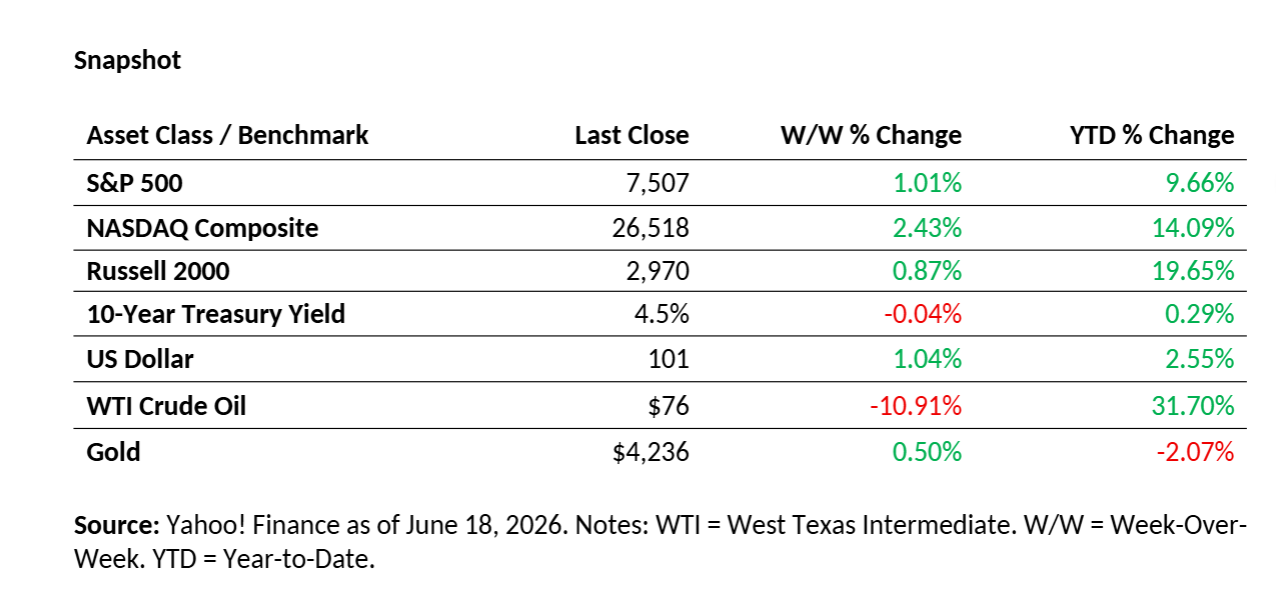
Markets closed out a shortened trading week on a positive note as investors navigated a lighter calendar ahead of the Juneteenth holiday on June 19, which resulted in one fewer trading day than normal. Despite the abbreviated week, risk assets continued to perform well, with gains across major equity benchmarks and signs of broad participation beneath the surface.
The S&P 500 advanced +1.01%, lifting its year-to-date gain to +9.66%. Technology stocks remained a leadership area, with the NASDAQ Composite rising +2.43%, extending its year-to-date return to +14.09%. Small-cap stocks also participated in the advance, with the Russell 2000 gaining +0.87%, bringing its year-to-date gain to +19.65%. The continued strength across large- and small-cap stocks suggests investor confidence remains constructive despite ongoing macroeconomic uncertainties.
In fixed income, the 10-Year Treasury yield declined –0.04%, finishing the week at 4.5%. The modest decline in yields provided a supportive backdrop for equities and suggests bond investors remain relatively comfortable with the current growth and inflation outlook.
The U.S. dollar rose +1.04%, pushing its year-to-date gain to +2.55%. A stronger dollar typically acts as a headwind for commodities and multinational earnings, making this week's equity gains particularly noteworthy.
Commodity markets were mixed. WTI crude oil declined –10.91%, though it remains higher by +31.70% year-to-date. The sharp pullback in oil prices may reflect easing supply concerns and profit-taking following a strong advance earlier in the year. Meanwhile, gold rose +0.50%, though it remains slightly negative year-to-date at –2.07%. The modest gain in gold suggests investors continue to maintain some exposure to portfolio diversification and risk management strategies.
Taken together, the cross-asset backdrop remains constructive. Equities moved higher, Treasury yields edged lower, the dollar strengthened, and commodity markets cooled. While the holiday-shortened week offered fewer trading days, investors appeared willing to look through near-term volatility and focus on a backdrop characterized by resilient economic activity, supportive earnings trends, and broadening market participation.
As Howard Marks reminds us, successful investing is not about accurately predicting every market move—it is about being prepared for a range of possible outcomes. This week's market action continued to reward investors who remain diversified, disciplined, and focused on long-term opportunities.
Why Infinite Space Doesn't Mean Infinite Profits
"Compound interest is the eighth wonder of the world." — Albert Einstein
The Universe Is Huge. Your Discount Rate Is Bigger.
Space feels limitless. Investing, however, has a way of bringing us back down to Earth.
Imagine humanity builds an interstellar civilization that generates $1 quadrillion every year ... forever. Sounds priceless, right?
Not quite.
Thanks to the magic—and brutality—of the Time Value of Money, those cash flows, beginning 100 years from now and discounted at 5%, would be worth only about $152 trillion today.
That's a staggering reminder that when you earn money can matter just as much as how much you earn.
"In this world nothing can be said to be certain, except death and taxes." — Benjamin Franklin
You might add one more certainty: Discount rates and compound interest never take a vacation.
The Market's Crystal Ball
Here's where things get really interesting.
Today's global stock market is worth roughly $150 trillion—remarkably close to the present value of our hypothetical interstellar civilization.
Coincidence?
Maybe.
Or perhaps markets are quietly telling us something profound: Investors expect humanity to keep innovating, adapting and growing for generations to come.
The stock market isn't pricing next week's headlines. It's pricing decades of human progress.
Choose Your Own Adventure
🌌 Option 1: The Capitalist Event Horizon
Just as light has a limit in space, investors have a limit in time.
Cash flows that arrive centuries from now simply don't carry much value today. At some point, compounding becomes stronger than optimism.
🚀 Option 2: The Human Survival Premium
Markets may also be making an enormous bet on us.
If investors truly believed civilization was nearing its end, today's stock market would likely trade at a far steeper discount.
Instead, global markets continue valuing businesses as though tomorrow—and many tomorrows after that—still matter.
Final Frontier
Space may someday become the next great economic frontier.
But for today's investors, Earth remains headquarters.
The biggest opportunities still come from solving today's problems while keeping an eye on tomorrow's possibilities.
As Carl Sagan reminded us:
"Somewhere, something incredible is waiting to be known."
Time In the Market, Not Timing the Market
"The future depends on what you do today." — Mahatma Gandhi
Investors often spend enormous energy trying to predict the next quarter, the next election or the next Federal Reserve meeting.
History suggests a better approach: Own great businesses and give them time.
Whether we're talking about artificial intelligence, space exploration or healthcare breakthroughs, innovation doesn't happen overnight—but neither does wealth creation.
Patience may be the most underrated investment strategy of all.
Human Interest
Imagine explaining to someone in 1926 that one day people would carry supercomputers in their pockets, talk face-to-face across continents, and seriously debate building data centers ... in orbit.
The future has a funny habit of arriving faster than expected.
"The best way to predict the future is to invent it." — Alan Kay
Fun Facts & Figures
🚀 Light from the Sun reaches Earth in about 8 minutes and 20 seconds.
🌍 Earth's public stock markets are worth roughly $150 trillion.
💰 At 5%, money doubles approximately every 14 years (Rule of 72).
🛰️ GPS satellites orbit Earth at roughly 8,700 mph—and they're still considered "slow" by space standards!
On This Day in History – June 22
📡 June 22, 1978: Astronomer James Christy announced the discovery of Charon, Pluto's largest moon—forever changing our understanding of the distant solar system.
"Across the sea of space, the stars are other suns." — Carl Sagan
Sometimes the biggest discoveries begin with simply looking a little closer.
Best Regards,
Andrew Zittell
Yerba Buena Financial Partners
Sources & Footnotes:
- WCG research and valuation analysis, June 15, 2026.
- Standard finance principles for present value, perpetuities and the Time Value of Money.
- Visual Capitalist estimates of global public equity market capitalization.
- Kardashev Scale framework for measuring technological civilizations.
- NASA and astronomical references regarding interplanetary exploration.
- Historical records documenting the discovery of Pluto's moon Charon.
- WCG calculations based on a 5% discount rate and perpetual cash flow assumptions.
Disclosures:
- Securities offered through LPL Financial, Member FINRA/SIPC. Investment Advice offered through WCG Wealth Advisors, LLC, a Registered Investment Advisor. WCG Wealth Advisors, LLC is a separate entity from LPL Financial.
- Bond yields are subject to change. Certain call or special redemption features may exist which could impact yield. (118-LPL)
- The S&P 500 is a stock market index tracking the stock performance of 500 of the largest companies listed on stock exchanges in the United States. Indexes are unmanaged and cannot be invested in directly. (102-LPL)
- The NASDAQ Composite Index measures all NASDAQ domestic and non-U.S. based common stocks listed on The NASDAQ Stock Market. The market value, the last sale price multiplied by total shares outstanding, is calculated throughout the trading day, and is related to the total value of the Index. Indexes are unmanaged and cannot be invested in directly. (112-LPL)
- The fast price swings in commodities will result in significant volatility in an investor’s holdings. Commodities include increased risks, such as political, economic, and currency instability, and may not be suitable for all investors. (122-LPL)
- There is no guarantee that a diversified portfolio will enhance overall returns or outperform a non-diversified portfolio. Diversification does not protect against market risk. (26-LPL)
The Russell 2000 Index is generally representative of the 2,000 smallest companies by market capitalization in the Russell 3000 index, which represents approximately 10% of the total market capitalization of the Russell 3000 Index. Indexes are unmanaged and cannot be invested in directly. Bonds are subject to market and interest rate risk if sold prior to maturity. Bond values will decline as interest rates rise. Bonds are subject to availability, change in price, call features and credit risk. The fast price swings in commodities will result in significant volatility in an investor’s holdings. Commodities include increased risks, such as political, economic, and currency instability, and may not be suitable for all investors.
Securities offered through LPL Financial, Member FINRA/SIPC. Investment Advice offered through WCG Wealth Advisors, LLC, a Registered Investment Advisor. WCG Wealth Advisors, LLC is a separate entity from LPL Financial.